










- Expert :
Master Crisis Management to protect your SME’s future. This comprehensive guide outlines the three critical phases Prevention, Response, and Recovery—and equips leaders with the skills to turn unexpected difficulties into strategic opportunities for growth and resilience.
Crisis Management is an indispensable skill for business leaders worldwide. Crises are an inevitable part of any organization’s lifecycle, sudden, unexpected situations that disrupt normal business operations and test the ability of individuals and enterprises to persevere and make decisions under extreme pressure. In a world of accelerating economic and technological shifts, proactive Crisis Management has become a strategic necessity to ensure organizational continuity and achieve a critical balance between risk mitigation and opportunity creation.
Definition of a Crisis and Its Types
A crisis is an urgent event or critical situation that threatens the stability of an entity, whether an organization, government, or community, requiring immediate and astute intervention to prevent the escalation of damages and restore control.
Crises vary based on their nature and area of impact, including:
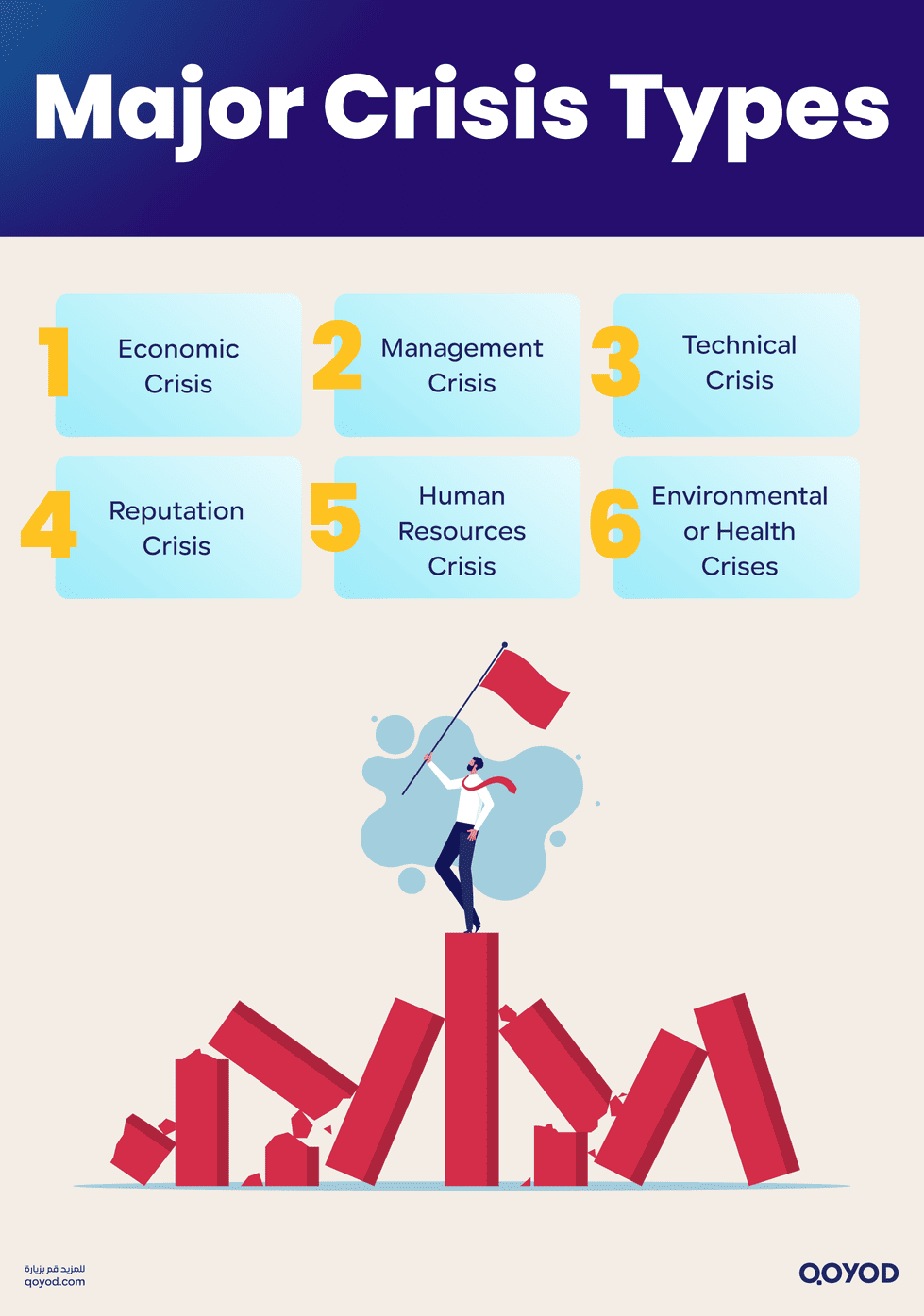
- Economic Crisis: A sudden drop in revenues or exposure to financial losses due to internal or external factors.
- Management Crisis: A failure in decision-making or weakness in planning and organization leading to institutional performance disruption.
- Technical Crisis: System failures or cyberattacks that threaten business continuity.
- Reputation Crisis: Damage to the public image due to communication errors or unethical practices.
- Human Resources Crisis: Internal conflicts or the loss of key competencies within the organization.
- Environmental or Health Crises: Such as natural disasters or pandemics that interrupt operational processes.
The Difference Between a Crisis and a Problem
A problem is often predictable, managed through routine procedures or pre-defined plans, and does not fundamentally threaten the organizational entity. A crisis, conversely, is a sudden event characterized by high intensity and speed, generating significant pressure that requires immediate, non-routine decisions. Its outcomes are often critical if not managed skillfully and wisely.
In other words, every crisis involves a problem, but not every problem is a crisis. The crisis carries the element of surprise and threat, while the problem remains within the framework of control and analysis.
The Importance of Proactive Crisis Preparedness in Modern Organizations
In an era of globalization and interconnected technologies, it is no longer sufficient for organizations to react to crises after they occur. They are required to adopt a proactive approach based on anticipating risks and developing contingency plans in advance.
Prior preparedness grants an organization:
- The ability to respond quickly to minimize losses.
- Clarity of roles and responsibilities during the management of the situation.
- Enhanced internal and external trust in management’s ability to maintain control.
- The capability to turn a crisis into a learning and improvement opportunity, rather than a breaking point.
Therefore, building an organizational culture that prioritizes preventive planning and trains employees in risk management represents a strategic step no less important than setting commercial goals.
Phases of Crisis Management
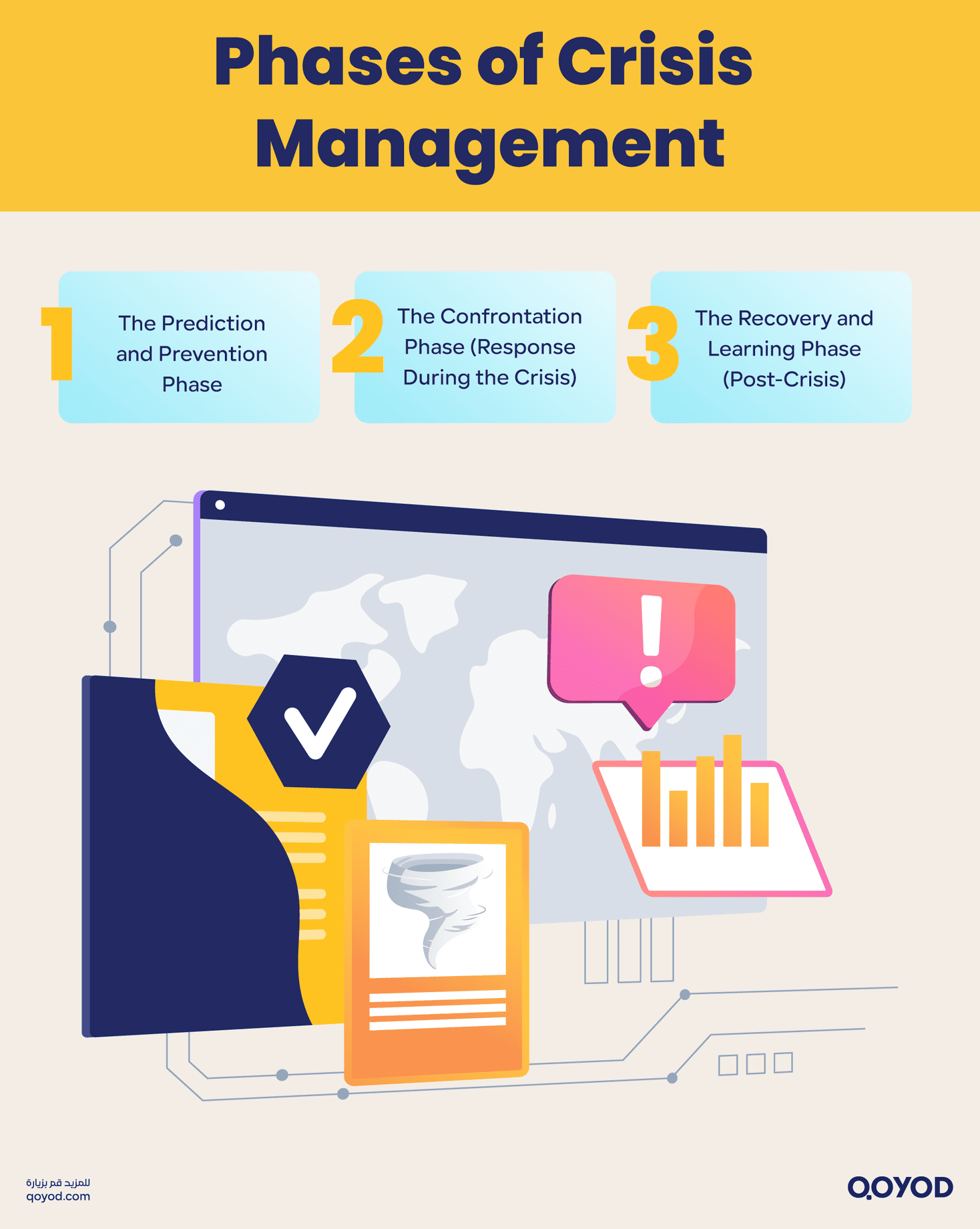
Effective Crisis Management is structured into three distinct phases, ensuring a methodical approach from prediction to recovery.
1. The Prediction and Prevention Phase
Effective Crisis Management begins before the crisis hits, through the analysis of the organization’s internal and external environment to monitor potential risks, such as financial, technical, operational, or reputational threats. This analysis helps classify risks based on their probability and severity of impact, establishing clear priorities for addressing or mitigating them.
Creating an early warning system based on performance indicators and continuous monitoring (e.g., increased complaints, recurring technical failures, customer satisfaction instability) enables the organization to detect the signs of a crisis before it escalates into a major threat. These efforts are then translated into a written Crisis Management Plan. This plan includes forming a crisis team, defining responsibilities, communication lines, and decision-making rules for critical situations, along with regular training and simulation programs to enhance employee readiness and minimize confusion during an event.
Crisis Management frameworks in large enterprises demonstrate that having a prior plan facilitates the response to events like cyberattacks and system outages. Such plans are based on the pre-crisis, crisis, and post-crisis stages, as explained by specialized training literature. Many studies also indicate that organizations investing in prior analysis and continuous learning from mistakes are significantly better prepared for future crises.
2. The Confrontation Phase (Response During the Crisis)
The confrontation phase begins when potential risks materialize into an actual crisis. This is where the Crisis Management Plan is activated, and the team responsible for leadership, coordination, and decision-making is formed. Crucial to this stage is gathering accurate and updated information about the crisis’s nature, its scope of impact on operations and reputation, and affected stakeholders, as decisions based on incomplete data escalate the damage.
Professional references in Crisis Management emphasize that the response must be swift but not rushed,balancing speed with quality,alongside effective internal and external communication management to maintain the trust of employees, customers, and regulatory bodies. This management includes formulating clear messages, appointing an official spokesperson, and unifying the media narrative to prevent contradictions and misunderstandings.
Crisis Management Plan Model
A common case study example involves a major retail company’s response to a customer payment card data breach. The company immediately announced the incident, cooperated with competent authorities, offered free credit monitoring services to affected customers, and radically upgraded its security systems. These immediate and integrated steps informing stakeholders, cooperating with authorities, and taking tangible corrective action represent a practical model of effective confrontation in Crisis Management.
3. The Recovery and Learning Phase (Post-Crisis)
After containing the crisis and controlling its most severe impacts, the organization moves into the recovery phase, aiming to resume core activities and restore operational and financial stability. This includes planning for Business Continuity and implementing procedures to address residual effects on employees, systems, and customers.
A central element in this phase is organizational learning, where a comprehensive review is conducted: how the crisis started, what were the strengths and weaknesses in the response, and what gaps appeared in the plan or execution. These lessons are documented and used to update Crisis Management plans, improve the governance structure, and strengthen control and communication systems. Sources also stress that rebuilding trust requires practical steps like transparent communication of lessons learned and demonstrable improvements in products, services, or protective controls.
Case studies of data breaches at credit information companies show that recovery did not stop at fixing technical vulnerabilities but included significant investments in information security, a change in senior management, and prolonged programs to restore customer and regulatory trust. These cases illustrate that the post-crisis phase, if leveraged well, can become a launchpad for building a stronger risk management and compliance culture.
Leader Skills in Crisis Management
An effective crisis leader combines cognitive, emotional, and behavioral skills. The most important are data-driven decision speed, clear communication, composure under pressure, and building team morale and trust.
1. Speed of Data-Driven Decision-Making
Academic studies indicate that a leader’s effectiveness in a crisis depends heavily on their skill in making decisive choices in complex environments, relying on data and analysis rather than mere impressions. Specialized literature recommends training leaders to utilize analytical technologies and consult experts to build information-backed decisions, especially in high-risk environments.
Successful leaders outline multiple alternatives, evaluate the short and long-term consequences of each option, and then quickly choose the most appropriate path, while remaining ready to adjust the decision if new information emerges.
Example: Studies on government hospitals during the COVID-19 pandemic showed that administrative leaders who were faster in making decisions to redistribute staff and modify service pathways contributed to better containment of the crisis, relying on daily operational data, occupancy indicators, and critical case figures.
2. Effective Internal and External Communication During the Crisis
Clear communication is a pillar of Crisis Management. It helps the leader reassure the team, unify efforts, and reduce rumors both inside and outside the organization. Recommended practices include designating an official spokesperson, using established formal channels, and regularly updating information to match the situation’s evolution.
The successful administrative leader builds a bridge of trust with stakeholders through relative transparency, acknowledging the problem, and explaining the measures being taken, instead of denial or ambiguity which widens the gap with the public.
Read More: The impact of crisis and disasters risk management in COVID-19 times: Insights and lessons learned from Saudi Arabia
3. Ability to Maintain Composure in a High-Pressure Environment
The most critical quality for a leader in a crisis is the ability to manage their emotions, as a leader’s tension directly reflects on the team’s performance, increasing their confusion. Composure here is viewed as a practical skill built on prior preparation, clarity of roles, and training on crisis scenarios, which mitigates the element of surprise.
Effective leaders balance firmness with empathy; they maintain composure in front of the team while acknowledging the difficulty of the situation and providing necessary support so that employees do not feel alone in the confrontation.
4. Building Trust within the Team and Maintaining Morale
Trust and cooperation are crucial for overcoming crises. The leader builds this trust by involving the team in discussions and solutions, and not concealing essential facts (provided it does not harm the recovery process). Research confirms that creating an environment of mutual respect and providing professional and psychological support increases employees’ willingness to absorb additional pressure during the crisis.
Morale is maintained not just by promises, but by tangible actions like fair distribution of burdens, providing protective resources, and offering channels to listen to employees’ feedback and concerns.
Strategies for Transforming Crises into Opportunities
Turning crises into opportunities requires a strategic mindset that sees every disruption as an entry point for development, and every pressure point as a catalyst for innovation and stronger rebuilding. Organizations that adopt this perspective often emerge from crises more efficient and competitive.
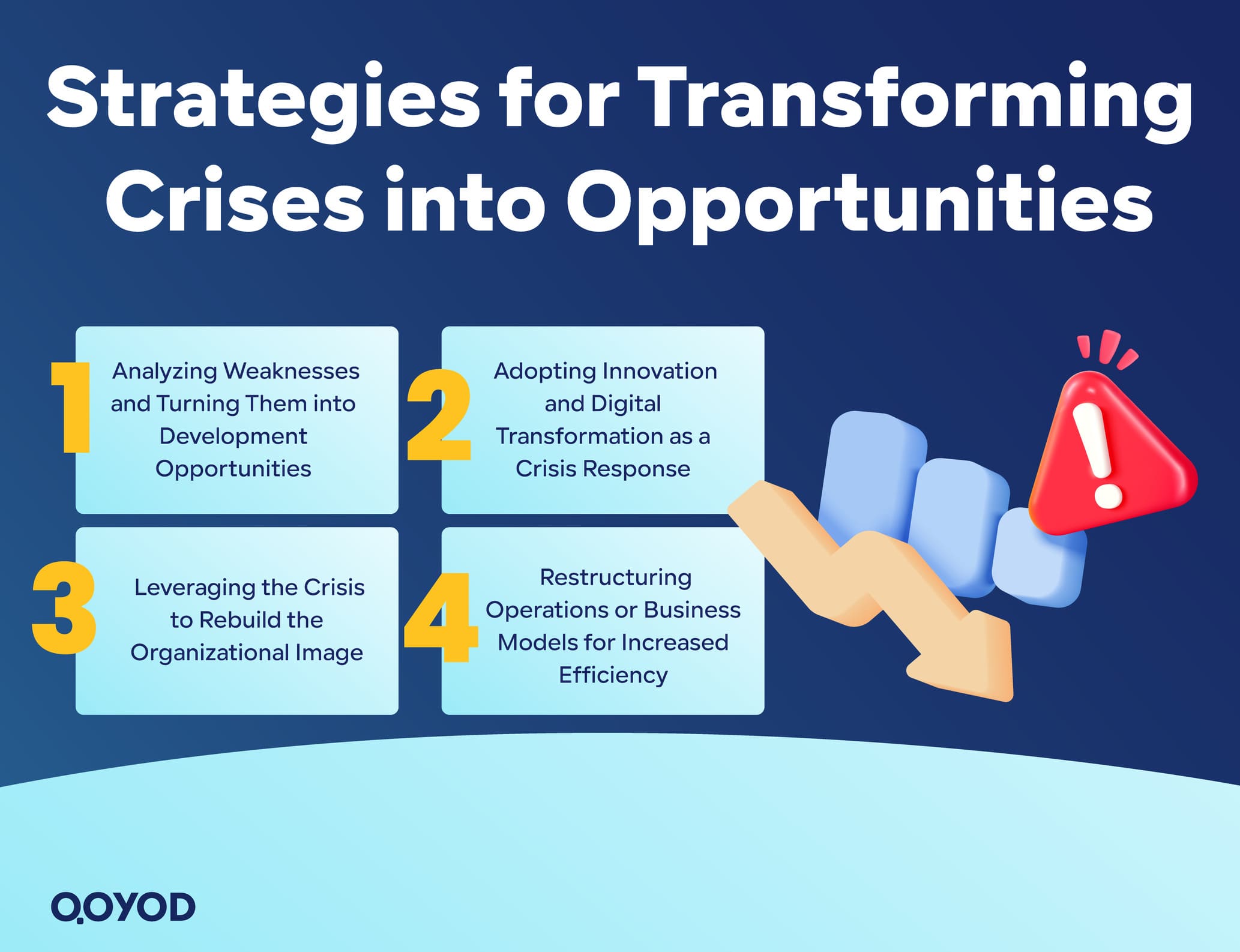
1. Analyzing Weaknesses and Turning Them into Development Opportunities
A crisis often exposes vulnerabilities in systems, processes, or the work culture that were not apparent under normal circumstances such as weaknesses in supply chains, slow decision-making, or shortcomings in customer service. The leader must transform the crisis into a “free reality check,” collecting observations, analyzing shortcomings, and then converting them into a clear improvement plan encompassing the development of procedures, skills, and the technical infrastructure.
Practical Example: During a famous global quick-service food company crisis, a decline in customer satisfaction and increased criticism led to the launch of a comprehensive program to improve the recipe, develop delivery service standards, and adopt customer feedback as a primary input for change. This model can be applied to any organization: Collect crisis observations, analyze them, and transform them into an integrated development program instead of settling for a temporary reaction.
2. Adopting Innovation and Digital Transformation as a Crisis Response
Crises, especially health or economic ones, push organizations to seek new ways of working, opening the door for Digital Transformation and innovation in service and product delivery. This includes using digital tools for internal communication, automation in repetitive processes, and real-time data analysis for faster, more accurate decision-making.
Studies on Digital Transformation in Crisis Management show that adopting technologies like cloud computing, remote work systems, and advanced analytics enabled many organizations to continue operating during crises, which later transformed into a competitive advantage that reduced costs and increased operational flexibility.
Practical Examples:
- In the healthcare sector, the COVID-19 crisis accelerated the adoption of telemedicine, real-time dashboards, and digital appointment platforms, making health systems more efficient even after the crisis subsided.
- In utility and service companies, crises drove the adoption of digital platforms for emergency and complaint management, and real-time fault tracking, which improved response time and reduced operational losses.
3. Leveraging the Crisis to Rebuild the Organizational Image
A crisis can harm reputation, but it is also an opportunity to demonstrate a high level of responsibility, transparency, and dedication to the customer or community, which can flip the narrative from negative to positive in the medium term. Organizations that admit the problem, take responsibility, and clearly announce fundamental corrective actions often earn greater respect than before.
Case studies indicate that rebuilding reputation after a crisis goes through sequenced steps: public admission, offering an apology or responsible clarification, taking practical actions (such as product withdrawal or policy change), and then continuous communication with the public about the improvements made.
4. Restructuring Operations or Business Models for Increased Efficiency
Crises sometimes reveal that the current model is costly or inflexible, necessitating the redesign of operations or even the Business Model to be more efficient and agile. This can include: reducing procedural steps, merging redundant units, relying on partnerships instead of internal building for everything, or shifting from a traditional sales model to a subscription or digital services model.
Practical experiences show that many companies used crisis periods to accelerate postponed projects such as electronic archiving, branch redistribution, or unifying technical systems, which subsequently led to reduced operating costs and improved service quality.
Practical Examples:
- During economic crises, some companies shifted from relying on traditional sales channels (many showrooms and branches) to a model relying more on digital platforms and delivery, thereby lowering fixed costs and expanding geographical reach.
- In the service sectors, administrative crises drove some institutions to merge similar departments and simplify the organizational structure, coupled with the automation of some procedures, which significantly increased the speed of transaction completion and reduced operational errors.
Frequently Asked Questions (FAQ) about Crisis Management and Turning Difficulties into Opportunities
What exactly is a crisis?
A sudden event threatening an organization’s stability (e.g., financial collapse, cyberattack), unlike a predictable daily problem. It demands immediate response to avert collapse, covering economic, managerial, technical, and reputational types.
Why is preparedness vital in Crisis Management?
Preparedness ensures speed of response, clear roles, and enhances confidence, reducing losses by 30-40%. In modern SMEs, it involves contingency plans and drills.
What are the three main phases of Crisis Management?
Prediction & Prevention (risk monitoring), Confrontation (rapid response), and Recovery (analysis and improvement).
What are the essential leader skills during a crisis?
Data-driven decision speed, effective communication, composure under pressure, and building team trust.
How does a leader turn a crisis into an opportunity?
By analyzing weaknesses, adopting digital innovation, rebuilding reputation, and restructuring operations. Example: shifting to digital sales during an economic downturn to boost efficiency.
Is Digital Transformation necessary in crises?
Yes, it speeds up response and lowers costs, as seen in the adoption of telemedicine during the pandemic, improving long-term efficiency.
How can we build a crisis management culture in an organization?
Through regular drills, contingency plans, and fostering communication. This transforms the team into an agile, resilient machine.
In Conclusion
In the fast-paced business world, crises are not the end of the road but pivotal turning points that test the strength of organizations and the creativity of their leaders. Through proactive preparedness, rapid response, and learning from experience, difficulties can be transformed into genuine opportunities for growth, whether by improving operations, enhancing reputation, or adopting digital innovation. The successful leader is one who views every crisis as a call to rebuild stronger, founded on their skills in calm decision-making and effective communication.
Possessing accurate and comprehensive financial data,such as daily cash flow reports, cost analysis, and liquidity indicators,is a strategic weapon in facing crises. This data enables the leader to:
- Assess the Precise Impact: Know the exact scale of immediate losses and set priorities, such as cutting non-essential expenses without disrupting operations.
- Make Supported Decisions: Identify available financial options, such as debt refinancing or budget reallocation, which reduces risks by up to 40%.
- Plan for Recovery: Outline future scenarios based on revenue forecasts, and convert weakness into efficiency, as demonstrated by companies that used their data to shift to digital models during crises.
With this data, Crisis Management transforms from an emotional reaction into a precise, calculated process, ensuring business continuity and enhancing long-term competitiveness. Start building your financial data system today. Success in a crisis begins with a clear vision.
Try Qoyod Accounting Software now to make your business operations easier and more accurate with solutions designed for modern businesses.